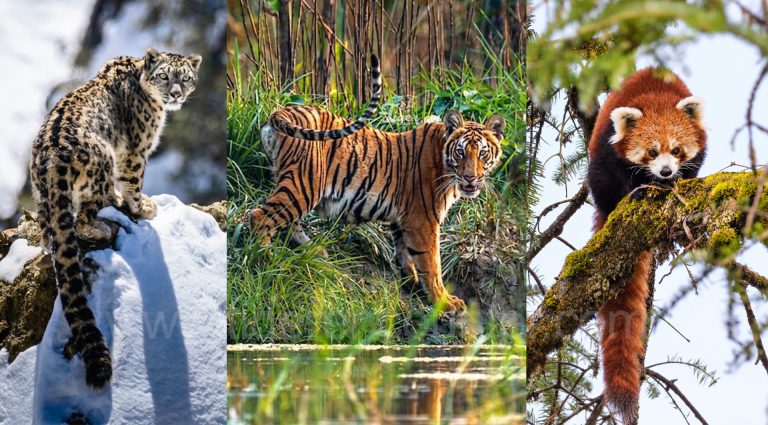
Lions and tigers are the most iconic members of the big cat family — symbols of strength, courage, and majesty. While both belong to the Panthera genus, they each rule very different worlds: lions in the grasslands of Africa and tigers in the jungles of Asia.
Lions: “The King of the Savannah” dominates open grasslands where teamwork ensures survival.
Tigers: “The Lord of the Jungle” rules silently, relying on camouflage and solitary power in dense forests.

Similarities Between Lions and Tigers
- Same Family Lineage
Both lions (Panthera leo) and tigers (Panthera tigris) belong to the Felidae family and Panthera genus, known for their ability to roar — a sound produced by a special ligament in their voice box. - Carnivorous Diet They are apex predators that feed mainly on large mammals. Lions hunt zebras, buffaloes, and antelopes, while tigers prey on deer, wild boar, and even gaur.
- Territorial and Powerful Hunters
Both species are highly territorial. They use scent markings, roars, and physical displays to defend their ranges from rivals. - Social Communication
Both lions and tigers communicate through roars, growls, and scent markings. Roaring serves as a territorial announcement and a means of locating other members. - Endangered Status
Both are listed as Vulnerable or Endangered due to habitat loss, poaching, and human-wildlife conflict. Conservation programs across Africa and Asia aim to protect their dwindling populations.

Differences Between Lions and Tigers
Habitats and location:
Tigers live in Asia, while lions are primarily found in Africa, with one notable exception. One of the key differences between these two big cats is their preferred habitat. Tigers thrive in dense forests, which allow them to stalk their prey undetected. In contrast, lions inhabit open plains, where there is little to no cover.
The vast African savannas serve as the main habitat for lions, and today most populations are found in sub-Saharan African countries, including Tanzania, Kenya, Namibia, South Africa, Botswana, and Zambia. While lions are nearly extinct outside Africa, a small population of about 500 Asiatic lions still survives in a nature reserve in northwestern India.
Tigers, on the other hand, are found only in Asia. In Nepal, Bengal tigers are found in protected areas like Chitwan National Park and Bardia National Park. They inhabit dense rainforests, open forests, and even some savanna regions. These specific environmental conditions provide tigers with the ideal settings to hunt, live, and reproduce successfully.
Color Patterns and Appearances
Lions have a yellowish-brown coat, sometimes showing faint spots as cubs, and male lions are distinguished by their thick manes, which help protect their necks during fights and attract mates. Tigers, in contrast, have orange coats covered with bold black stripes that extend across their entire bodies, providing excellent camouflage in tall grasses.
Size and Weight:
In terms of size, lions typically weigh between 330 and 550 pounds (150–250 kg), while tigers can grow even larger and reach up to 660 pounds (300 kg) or more — making them the largest cats on Earth.

Social Behavior:
The social behavior of lions and tigers is drastically different. Lions are the only truly social big cats, living in prides that usually consist of several lionesses, their cubs, and one or more dominant males. This group structure enables them to coordinate hunts efficiently and defend their territory as a team.
Tigers, on the other hand, are solitary animals. Except during mating or when a mother is raising her cubs, tigers prefer to live and hunt alone. Encounters with other tigers are rare and often territorial, which means tigers must rely on stealth and self-sufficiency far more than lions do.
Hunting styles
Lions and tigers are both powerful predators, but their hunting strategies reflect their different lifestyles. A lion is generally a more efficient hunter than a tiger because of its cooperative hunting strategy, with a pride achieving a much higher success rate than a solitary tiger. Although tigers are physically stronger and formidable solo hunters, their individual hunting success is lower, estimated at 5–10%, compared to a lion pride, which can reach around 60%.
In a lion pride, female lionesses are the primary hunters, working together to bring down large prey such as zebras, wildebeest, and gazelles. Male lions rarely hunt, but they step in for especially large prey and focus primarily on protecting the pride and its territory.
Tigers, as solitary hunters, rely on their strength, stealth, and patience. They use their powerful hind legs to launch sudden ambushes on prey, including deer, wild boar, and even large animals like gaur. Bengal tigers, in particular, are highly versatile hunters, skillfully navigating forests, grasslands, and wetlands to catch their prey.
Compared to other big cats, tigers are exceptional swimmers. They can dive into rivers to ambush prey, using the water as cover to hunt more effectively.

Conservation Status:
Both lions and tigers face serious threats in the wild. The IUCN classifies lions as Vulnerable, with only about 20,000 remaining in the wild, and lists tigers as Endangered, with fewer than 4,000 surviving in just 7% of their historical range. The primary dangers to both species are habitat loss, poaching, and human-wildlife conflict.
Interesting Facts About Lions and Tigers
- Lions and tigers are the two biggest cats in the world.
- A group of lions is called a pride, while a group of tigers is known as a streak or ambush.
- Male lions have manes — a feature that protects them during fights and attracts females.
- Tigers have better swimming abilities and often cool off in rivers and lakes.
- Lions and tigers are both apex predators, but their hunting success rate differs. Lion hunting success rates are higher than those of tigers due to their social hunting strategy, with a cooperative kill rate of around 30% versus a solo hunt rate of about 10% for tigers, meaning they are successful in about 1 out of every 5 to 10 hunts.
- Tigers are the national animal of India, revered for their strength and beauty.
Lions and tigers are both majestic predators that represent the wild power of nature. Lions rule the open plains of Africa with teamwork and pride. While tigers dominate the jungles of Asia through stealth and strength.
Although their worlds differ, both species face a common challenge: survival on a rapidly changing planet. Protecting them is not just about saving two animals, but about preserving the soul of the wilderness itself.

The Ultimate Lion & Tiger Safari – From Tanzania to Nepal
Embark on a once-in-a-lifetime Big Cat Safari Adventure, where Africa meets Asia in the wild. Witness the majestic lions of Tanzania’s Serengeti and track the elusive Bengal tigers of Nepal’s Bardia National Park. Two legendary predators in two extraordinary landscapes.
From the golden savannahs of Tanzania to the lush jungles of Bardia, experience thrilling lion and tiger guided safaris, luxurious eco-lodges, and breathtaking moments in nature’s raw beauty.